I am excited to share that our paper, “Thermal and Tactile Integration in Human Liquid Perception Using Viscous Solutions and Visible Light,” was accepted to IEEE Haptics Symposium 2026 and received the Best Technical Long Paper Award.
This work explores a deceptively simple question: how does the human brain decide that something feels like a liquid, and can we actively manipulate that perception?
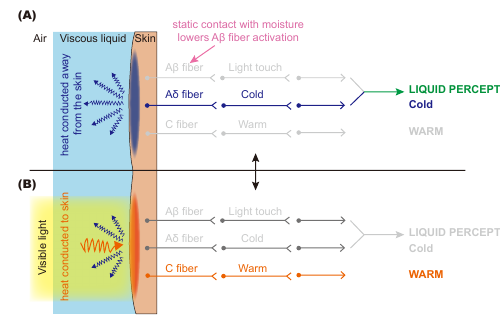
Humans do not have dedicated wetness receptors. Instead, liquid perception emerges from the integration of multiple sensory cues, especially thermal and tactile information at the skin. In this study, we show that the sensation of being in contact with liquid can be systematically reduced by controlling skin warming and the viscosity of the surrounding medium.
Core Idea
The study was motivated by a multisensory view of liquid perception. A cool liquid can draw heat away from the skin and evoke cold sensation, while subtle motion and contact at the skin provide tactile cues. Together, these inputs help the nervous system construct the percept of liquid.
We asked whether this percept could be shifted by changing the balance of these cues. Specifically, we used:
- Visible light to selectively warm the skin while the hand was immersed in liquid.
- Xanthan gum solutions with different viscosities to reduce dynamic tactile cues from the liquid.
The key idea is that increasing warmth and reducing tactile flow cues should make the medium feel less liquid, even though the hand is still physically immersed in a liquid-like substance.
Hydroptical Thermal Feedback
To control skin temperature without directly heating the whole liquid, we used a hydroptical thermal display. Visible light passes through water and xanthan gum solution with minimal absorption, allowing thermal radiation to warm the skin surface while keeping the surrounding medium cool.
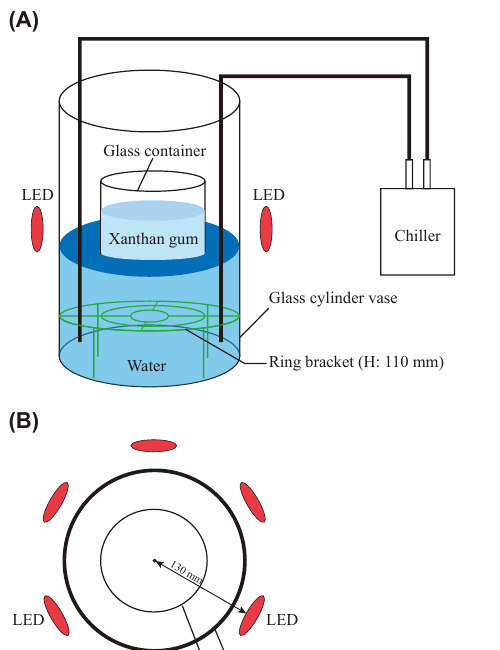
This setup allowed us to decouple two components that are usually tied together in real liquid contact: the temperature of the medium and the temperature experienced at the skin. Participants immersed their fingers in a cool viscous solution while LEDs delivered controlled light intensities to the submerged skin.
Viscous Liquid Medium
We used xanthan gum solutions at 1%, 2%, and 3% concentrations. Xanthan gum is transparent enough for visible-light stimulation and provides tunable viscosity, making it suitable for manipulating tactile cues while preserving liquid-like contact.
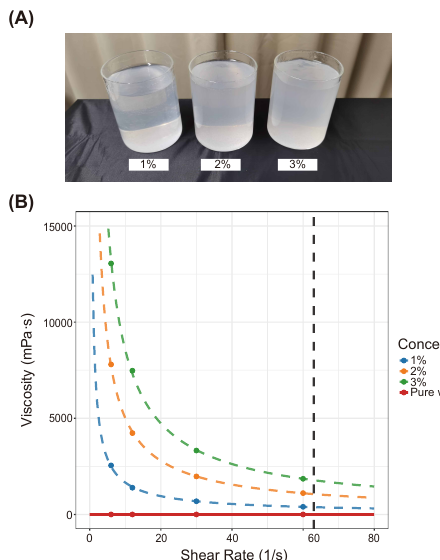
Higher concentrations produced higher viscosity and stronger shear-thinning behavior. In the context of finger-liquid interaction, this means the medium resists small movements more strongly and reduces the dynamic tactile information that usually contributes to liquid perception.
Experimental Setup
Participants placed the fingers of one hand into the viscous liquid while continuously reporting their perceived liquid sensation using a slider. The LED stimulation was hidden from view, and participants wore sunglasses to reduce visual cues and glare.
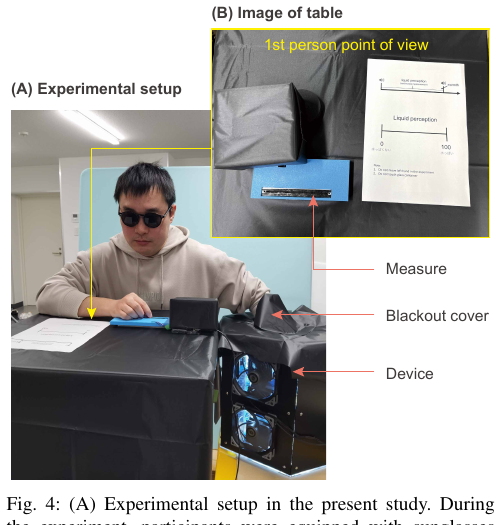
The experiment used a continuous visual analogue scale from 0 to 100, where 0 indicated no liquid perception and 100 indicated the strongest imaginable liquid perception. This made it possible to track the time course of perceived liquidity as light stimulation changed.
Main Findings
In Experiment 1, we varied light intensity while keeping solution viscosity constant. When the LEDs were turned on, liquid perception decreased after a short delay, while perceived warmth increased. Stronger light led to a larger reduction in liquid perception.
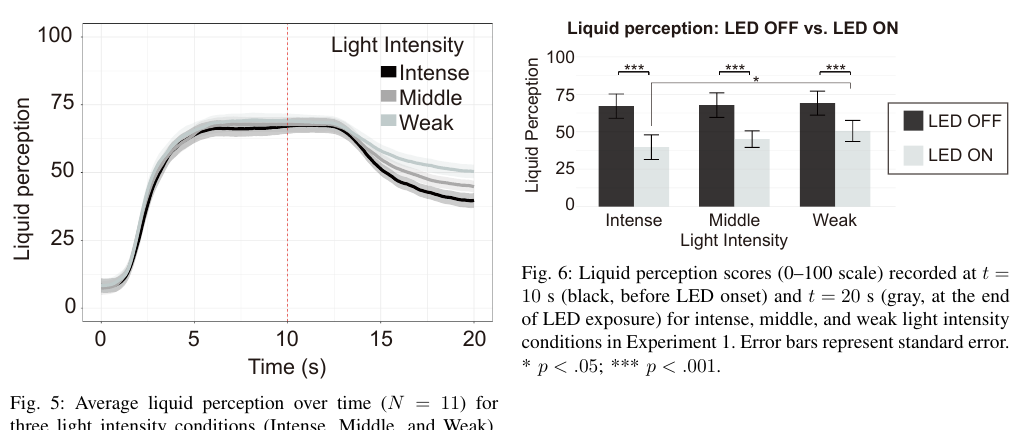
One important temporal feature was the delay: liquid perception did not drop immediately after LED onset. Instead, the decrease appeared after roughly 2.5 seconds, suggesting that liquid perception is not a simple reflex-like response but an interpretive process that takes time to integrate sensory evidence.
In Experiment 2, we varied solution viscosity. Higher viscosity reduced perceived liquid sensation, supporting the idea that dynamic tactile cues are essential for the percept of liquidity.
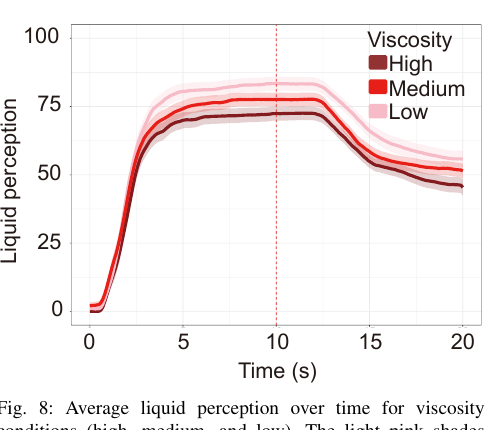
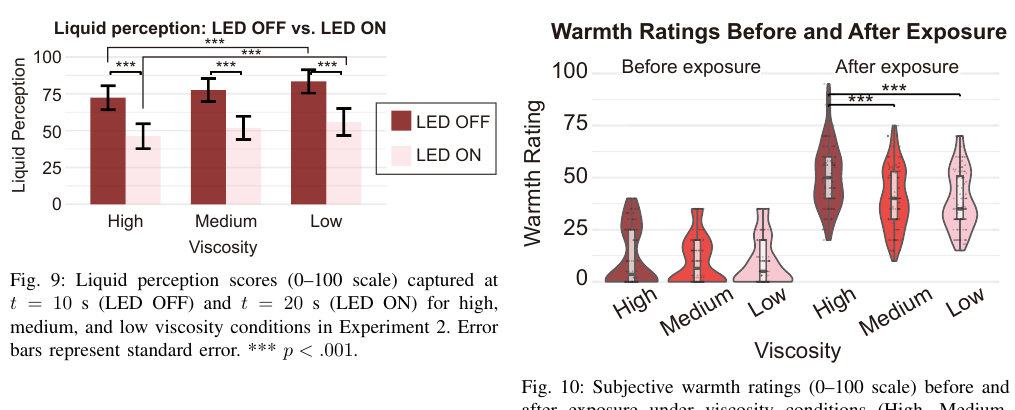
The summary results showed that LED stimulation reduced liquid perception across viscosity conditions, while higher viscosity further suppressed perceived liquidity. Participants also reported stronger warmth after light exposure.
Why It Matters
This paper demonstrates that liquid perception is not a fixed property of physical liquid contact. Instead, it is an actively constructed multisensory experience that can be manipulated by controlling thermal and tactile inputs.
For haptic interface design, this provides a path toward rendering the state of a medium, not only the properties of solid objects. Hydroptical thermal feedback could help simulate liquid, dryness, or changing material states in virtual reality, augmented reality, teleoperation, and rehabilitation systems without requiring the full physical presence of the target medium.
Authors
- Junjie Hua - Faculty of Design, Kyushu University, Japan; Experience Design, Bentley University, USA
- Sosuke Ichihashi - Digital Media, Georgia Institute of Technology, USA
- Hsin-Ni Ho - Faculty of Design, Kyushu University, Japan
This work was supported by JSPS KAKENHI Grant Number 23K24934 and the Kyushu University Reform Plan for Activation Program.
